
The Life, Death and Decay of Bombay Beach and the American Dream
April 2023
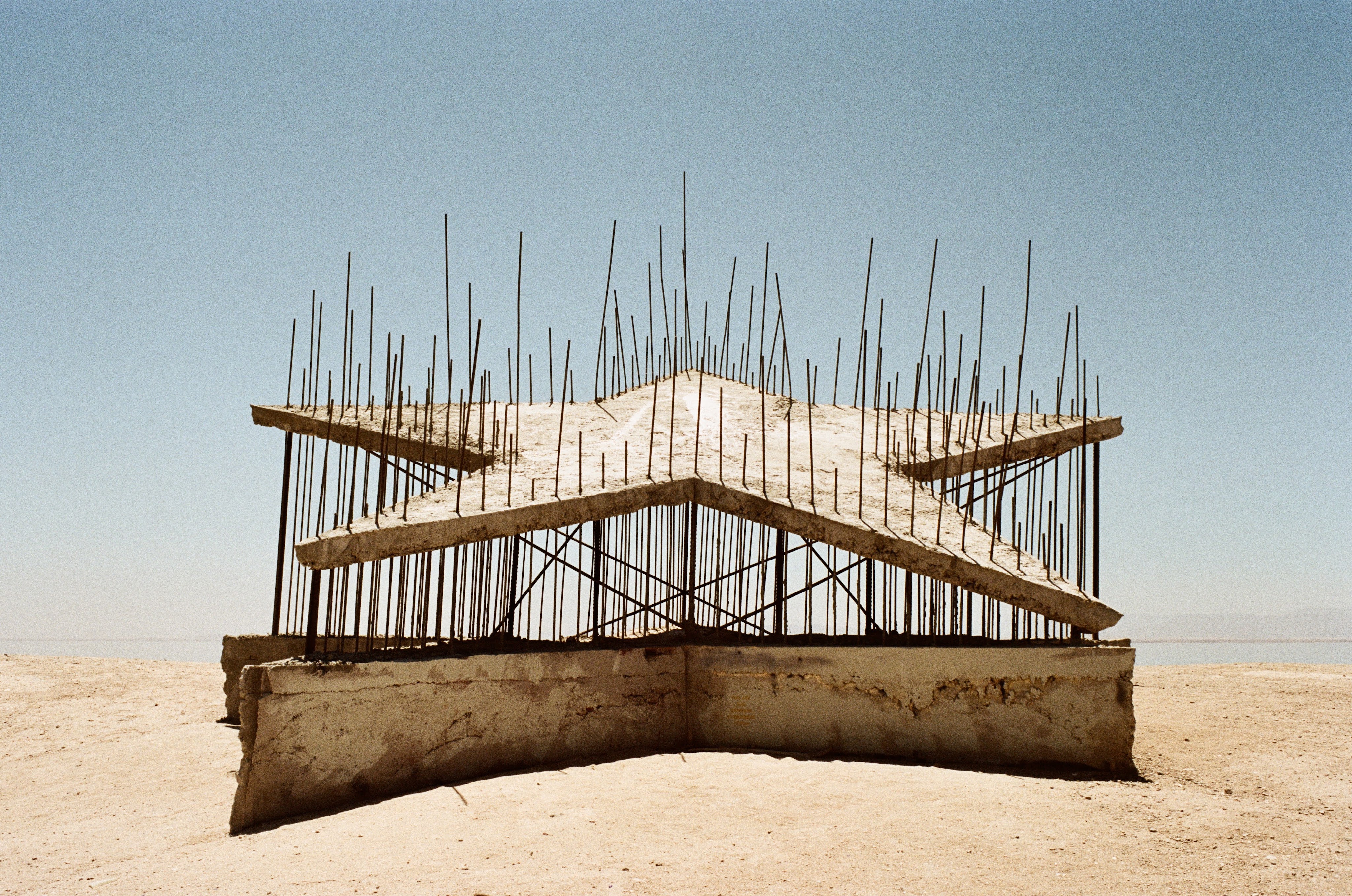
A sculpture at Bombay Beach, 2022. Photograph by Ben Clark.
Standing on the shore at Bombay Beach, California, gazing out across the murky waters of the Salton Sea, the final lines of Percy Shelley’s Ozymandias come to mind:
“My name is Ozymandias, King of Kings;
(1818)
Look on my Works, ye Mighty, and despair!
Nothing beside remains. Round the decay
Of that colossal Wreck, boundless and bare
The lone and level sands stretch far away.”
Bombay Beach, a once thriving resort community on the shore of the Salton Sea, is a town straddling the boundary between life and death. A faded billboard of four gleeful, mid-century water-skiers welcomes visitors to a lake far too toxic to swim in. Scores of houses lie abandoned on a beach made up of millions of fish bones, slowly decaying in the stifling desert air. The few permanent residents that remain live isolated lives— shuttered in their homes to escape the heat, and with few public services available.

Billboard at the entrance to Bombay Beach, 2022. Photograph by Ben Clark.
Although Bombay Beach is decades past its heyday, in recent years it’s been experiencing a cult resurgence. Artists travel from across the continent to populate the town with eclectic art installations and sculptures, and visitors travel to see this art in its desolate, quasi-apocalyptic setting. This trend is the latest addition to the sesquicentennial legacy of human meddling and mistakes around the ongoing natural disaster of the Salton Sea. Viewed as a collective entity, Bombay Beach and all its art stand as a monument to the absurdity of the rampant consumer culture of mid-century America, and a perverted sense of the American Dream.
Part One: Defining a Dream
Academically speaking, the American Dream is a vague, amorphous concept founded on intangible terms such as “success,” “opportunity,” or “self-realization.” In media, it takes the form of cozy, white-picket-fence suburban life such as in David Lynch’s Blue Velvet, (1986) or the lavish excesses depicted in F. Scott Fitzgerald’s The Great Gatsby (1925). For this essay, I will be anchoring the American Dream to Walter Benjamin’s musings on phantasmagoria, Mark Lytle’s analysis of the emergence of post-war America’s consumer society, and Ulrich Blanché’s terms and definitions of consumer culture..
Benjamin’s Arcades Project lays an excellent foundation in this definition of the American dream. He describes spaces of entertainment which “glorify the exchange value of the commodity,” or “a framework in which […] use value becomes secondary.” (1999:18.) These spaces subsequently lull masses into a “phantasmagoria” or state of euphoric distraction which makes them susceptible to industrial or political propaganda. (1999:18.) By Benjamin’s logic, post-war America found itself in a phantasmagorical state as the nation grappled with looming economic uncertainty. Mark Lytle goes into extensive detail to describe America’s economic paradigm shift in his book, The All-Consuming Nation. Following the Second World War, the United States government implemented a series of Keynesian economic policies to stave off the economic crises that plagued the country after the First World War. The United States became, as Lytle puts it, “a consumer democracy in which opportunities for its citizens in the marketplace would have the same priority as traditional rights and liberties.” (2021:18.) A society geared toward industrialized production for warfare shifted toward the industrialized production of consumer products and infrastructure. Notably, this shift focused on producing consumable housing in the form of suburban development, and consumable transportation in the form of cars, as “the dream of mass homeownership and mass consumption became linked.” (2021:20) From an art history perspective, Ulrich Blanché provides a vital link between Benjamin and Lytle’s analyses in his book Banksy: Urban Art in a Material World. Drawing from economists and media theorists, Blanché frames the consumer society as one with a wide assortment of goods to create spheres of taste, fashion and style, and a robust communication system which generates meaning for commodities, and subsequent desire for said commodities. (2016:24.) The compulsion to consume is a moral directive in Western society; higher consumption favours economic stimulation over personal satisfaction, with criticism of the consumer lifestyle frequently being labeled as “un-American.” (2016:21.)
These perspectives in mind, the American Dream can be concretely branded as a lifestyle fixated on the pursuit of consuming commodities. Throughout this essay I shall deploy the terms “consumer culture” and “American Dream” as one and the same.
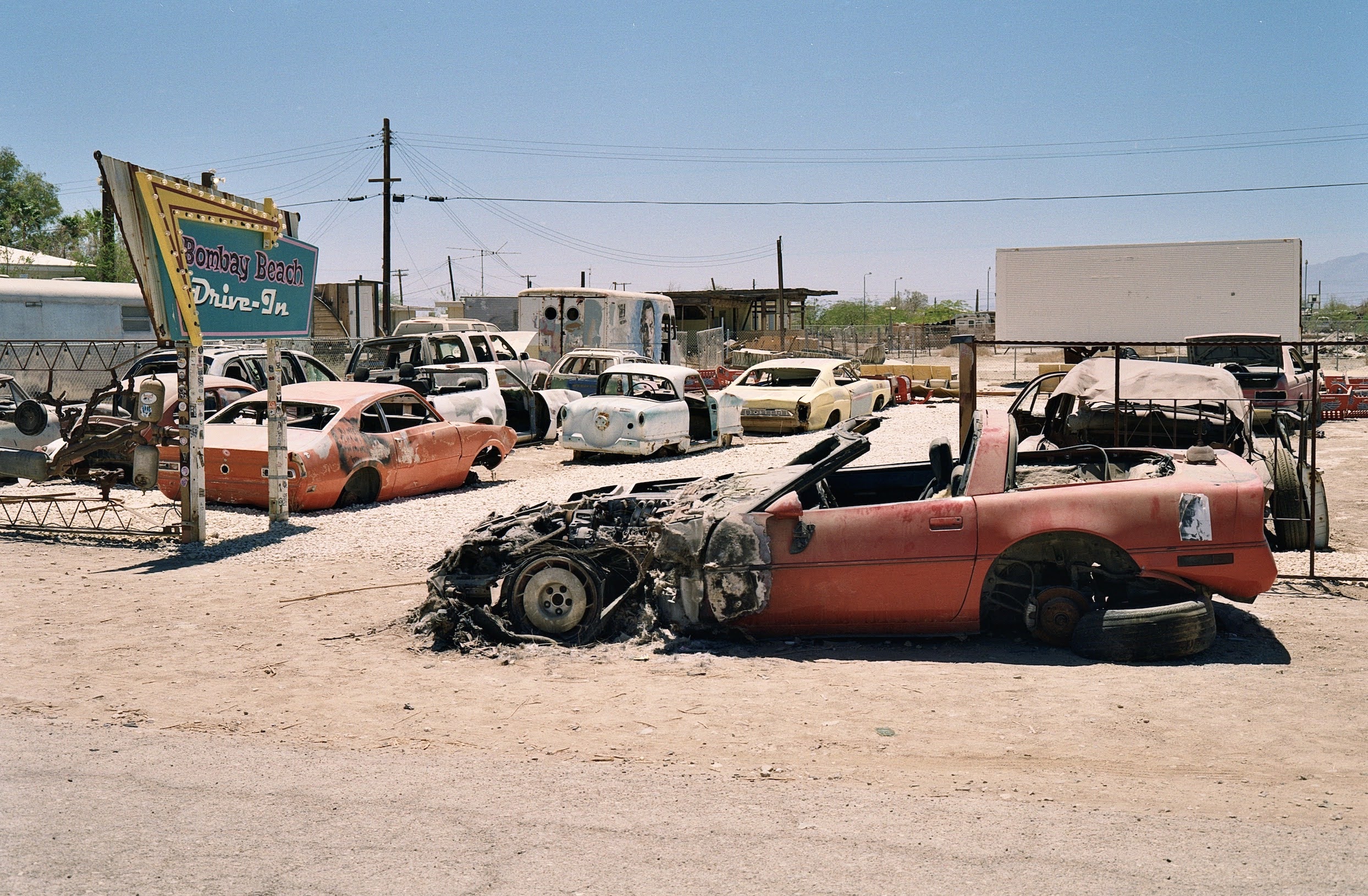
The Bombay Beach Drive-in, 2022. Photograph by Ben Clark.
Part Two: (Un)Natural Disasters
The Salton Sea has been a hotbed for commodification since well before Bombay Beach was established, and it is a foundational component of the town’s history. The Salton Sea is California’s largest inland body of water, measuring 24 kilometers wide and 56 kilometers long. Sitting 65 meters below sea level, it is a relatively new feature in the Imperial Valley desert, having been created by accidental human interference with the Colorado River in the early 20th century. (Tefler and Albrecht, 2014:40.) Traci Voyles provides a rich account of the Salton Sea’s creation in her book, The Settler Sea.
In the 1880’s— prior to becoming a lake— the then-called Salton Sink was a vast salt flat that was prone to semi-regular floods brought about by the meandering course of the nearby Colorado River. Settlers in the region established a highly lucrative salt-harvesting scheme on the flats, employing members of the local Cahuilla communities in brutally exploitative, assimilationist conditions. When they weren’t piling salt in the beating sun, workers lived in makeshift huts comprised of railway debris that was salvaged from around the region. Once during this operation, the Salton Sink flooded, destroying the Cahuilla’s living quarters, which they were forced to rebuild. Elsewhere in the then-named Colorado Desert, the California Development Company (CDC) was attempting to persuade settlers to envision the desolate, arid land as a fertile paradise ripe for farmland and development. The CDC rebranded the region as the “Imperial Valley,” in the spirit of colonial intervention which would deliver the water that would bring all the settlers’ dreams to life. At the time, the CDC was busy at work building a set of irrigation canals to channel the Colorado River to the settlers’ promising farmland, exploiting any loophole they could find to lay legal claim to any water which passed through their canals. Ignoring the warnings of local indigenous groups, geologists, and frequent canal breaches, the CDC delivered the Imperial Valley its water. Not long after, in the winter of 1905, a buildup of river sediment diverted the Colorado River from its canal, sending it straight into the Salton Sink, where it continued to spill for a further two years before the CDC was able to successfully dam the river. (2021:55-74)
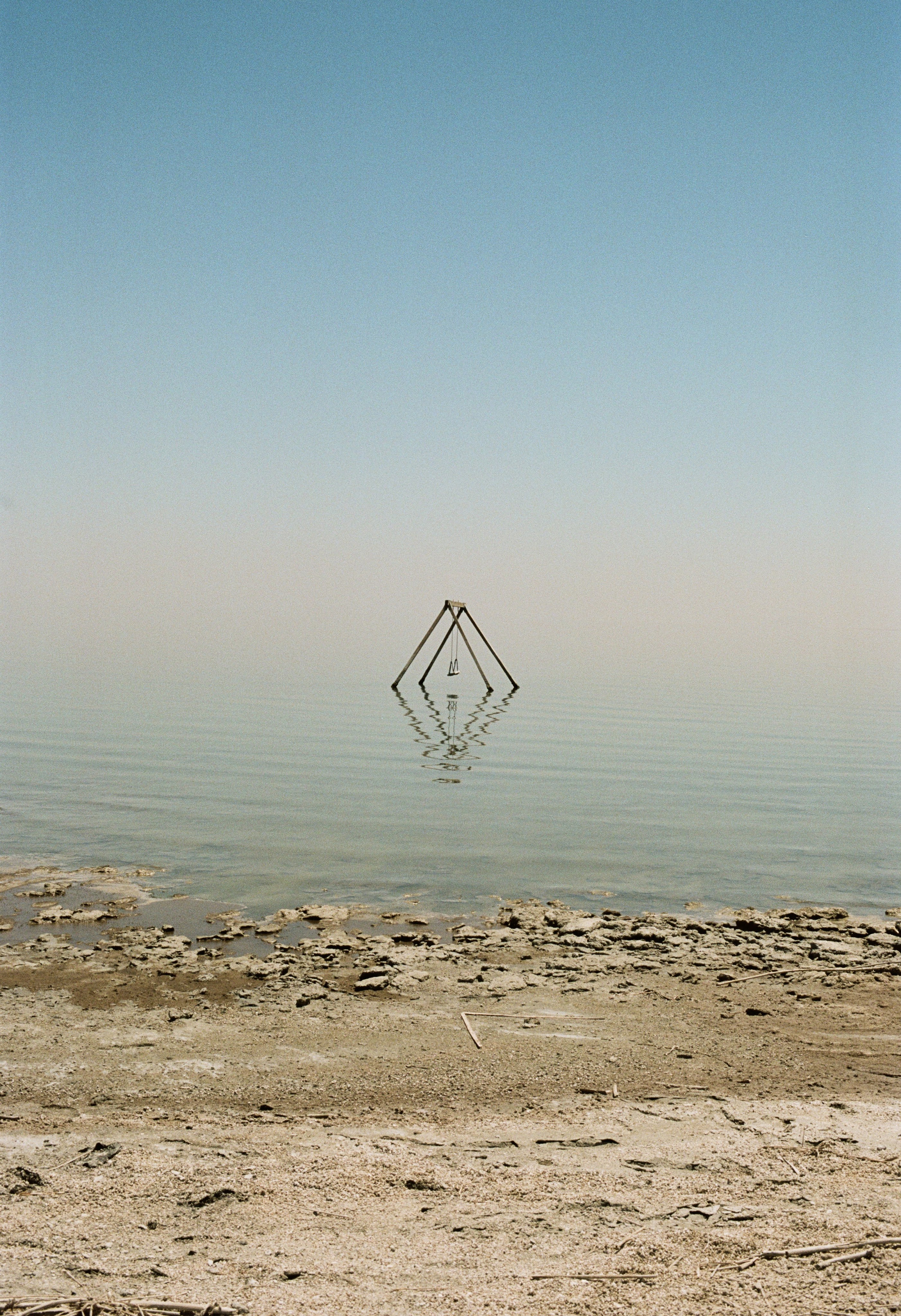
The Salton Sea Swing, 2022. Photograph by Ben Clark.
By the time the canal breach had been repaired, the Salton Sink had been transformed into an isolated, shallow, salty, 1,350-square-kilometer lake, devoid of life. Unlike previous flooding incidents, the water did not evaporate and return the Sink to being a profitable salt flat, effectively rendering the area useless for any commercial activity. George Durbrow, the proprietor of the Sink’s main salt-harvesting operation, subsequently filed a lawsuit against the CDC for its “hastiness, greed and incompetence” (in Voyles, 2021:64) as a last attempt at extracting some profit from the ruined landscape.
Part Three: Manufactured Paradise, Lost
While the farmland of the Imperial Valley thrived at the advent of water, the Salton Sea remained empty for decades as scientists and entrepreneurs tried to figure out how to put the lake to some use. As Sports Illustrated reporter, John O’Reilly aptly describes:
“From the viewpoint of sport fishermen, the Salton Sea has been an aggravation for more than a quarter of a century. There it has been—an enticing body of blue water with desert on both sides of it but with no fish worth catching. To the south lies Imperial Valley, once a howling desert but now, thanks to irrigation from the Colorado River, a fabulous producer of winter vegetables. To the north lies the Coachella Valley, where date palms, grapes and other crops are also nurtured by Colorado River water.”
(1957)
Starting in the late 1920’s, the California Department of Fish and Game attempted to introduce game fish to the lake to make it an appealing fishing destination. Scientists grappled with the lake’s severe temperature and water level fluctuations, as the lake’s water evaporated in the desert sun, and was replenished by water runoff from the neighbouring farmland. By the early 1950’s, they had successfully introduced a thriving population of orangemouth corvina, which, according to O’Reilly meant that the region had become poised for a fishing boom. (1957)
Bombay Beach was established on the east shore of the Salton Sea in 1929 , contemporary of the Department of Fish and Game’s early efforts to populate the lake with fish. It was an immediately attractive destination for Southern California sport-fishers and bird-watchers, steadily expanding over the years to cater to the growing influx of visitors. By the early 1960’s, the town had grown into a prosperous resort community with multiple hotels and bars, shops, a community centre, and other amenities to support tourists and permanent residents alike. (bbartsculture.org) At its peak, the town’s allure reached a kind of superstardom as a destination— famously hosting celebrities of the era such as Frank Sinatra, Bing Crosby, the Beach Boys, and Sonny Bono. (Abunassar, 2023.)
The development of Bombay Beach coincides with the proliferation of post-war American consumer culture. The 1960’s in particular— when the town reached its heyday— was an era that Mark Lytle describes as “the golden age of consumption.” (2021:174.) In line with the federal government’s Keynesian economic strategies, middle-class Americans experienced a period of high employment and high wages, which stimulated the economy through continuous spending. A development boom prompted Americans to flock to the suburbs to start families, and manufacturers distributed products in service of a lifestyle that was “fun, fashionable, fantastic and futuristic.” (Lytle, 2021:182.) Americans also enjoyed an era of greater mobility in leisure and recreation, as opportunities for travel and vacation homeownership were bolstered by mass car ownership. (Lytle, 2021:174-182.) Thus, when throngs of Californians bought vacation homes on Bombay Beach, or drove out with their camper-trailers and boats to exploit the shoals of corvina, the town became a concentrated manifestation of the dream of American consumerism. The above only describes one edge of the consumerist sword, however. The other edge, as Lytle notes, is disposability and waste. The 1960’s was also “the golden age of garbage,” as manufacturers also began implementing disposability and planned obsolescence as a means of spurring consumers to keep buying. (Lytle, 2021:178.)
Bombay Beach’s life-blood, the Salton Sea, is a man-made natural disaster that does not behave like other natural bodies of water. It has no consistent inflow, save for occasional flooding and farm water runoff, and no outflow except evaporation. When scientists were populating the lake with fish in the 1950’s, they predicted that the Salton Sea would be able to sustain marine life for around twenty-five years, before the lake’s salinity became toxic. (O’Reilly, 1957) In 1976, their prediction started to come true. The Salton Sea flooded once again, heavily damaging the resort communities which surrounded it. In the following years, fertilizer runoff that had leached into the water from neighbouring farmlands generated algae blooms which resulted in the die-offs of most of the Sea’s fish and birdlife. What few fish remained met their demise by the lake’s extreme salinity as the waterline receded. Most of the town’s businesses shuttered, and their residents abandoned their homes as the town became effectively defunct— blasted by toxic dust storms on the edge of a barren lake. (bbartsculture.org; Anderson, 2019.)
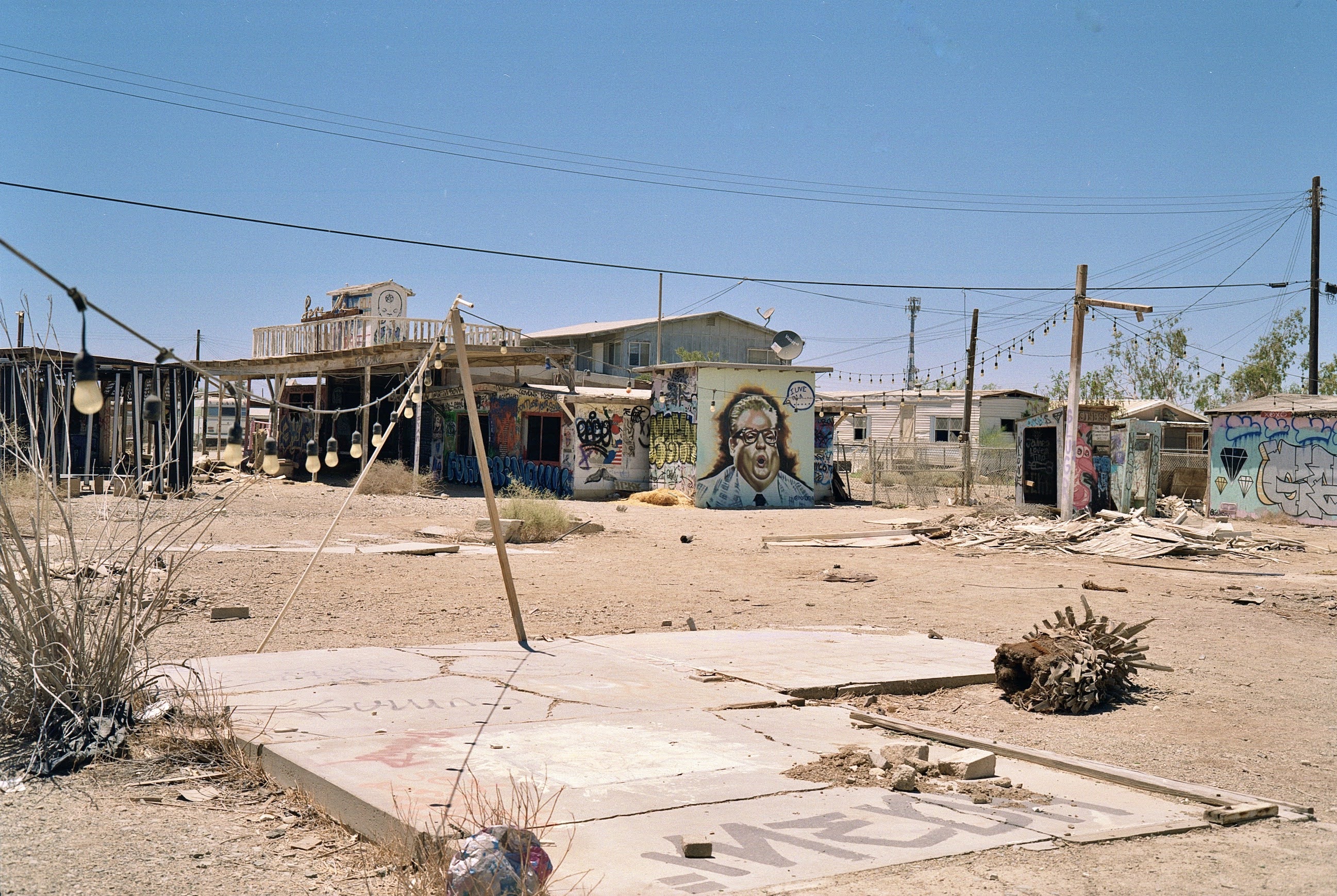
A neighbourhood in Bombay Beach, 2022. Photograph by Ben Clark.
Part Four: The Lone and Level Sands of Time
Understanding the history of Bombay Beach and the Salton Sea is vital in analyzing the cultural transformation the town is undergoing in the present day. Despite its history and advanced disrepair, Bombay Beach is still clinging to its legacy as a regional attraction, albeit now as an arts hub. Dozens of art installations are scattered throughout the town— littering the beach, and occupying every block. Many of these installations are made from scraps and debris salvaged from the town’s crumbling buildings, and are likewise left to the elements. Art started appearing en masse at Bombay Beach in the mid-2010’s with the advent of the Bombay Beach Biennale— a recurring, anarchistic arts festival founded by an LA-based hotelier and art collector, Stefan Ashkenazy, and painter-sculptor Greg Haberny. (Gerrie, 2019.) The festival aims to cultivate a “renegade celebration of art, music, and philosophy that takes place on the edge of civilization.” (In Abunassar, 2023.) They also claim to provide locals with access to an arts scene that otherwise would not exist in their isolated region, and artists with access to unrestrained creative space. (Gerrie, 2019; Abunassar, 2023.) The festival’s operations bear suspicious resemblance to an artwashing scheme, where public art is injected into disadvantaged communities as a gentrification tactic. (Pritchard, 2021:179.) This would be yet another profiteering attempt in the region’s long history of capitalist exploitation, if Bombay Beach and its art were not commercially worthless.

The Bombay Beach TV’s, 2022. Photograph by Ben Clark.
In Western culture, art derives value from an institutionally-sanctioned system of ownership, which rejects art that cannot be owned or assigned a commercial value. (Blanché, 2016:47) By overwhelming majority, the art at Bombay Beach is anarchistic and self-authorized, owned by and made for nobody and everybody. Consider Kracauer’s reflections on the Linden Arcades:
“The peculiar feature of the arcades is that they were passageways that passed through the bourgeois life that resided in front and on top of their entrances. Everything excluded from this bourgeois lifestyle because it was not presentable or even because it ran counter to the official world view settled in the arcades.”
(1995:338)
No longer a curated manifestation of capital and consumerism, Bombay Beach has become a space where the façade of the American dream has utterly collapsed, leaving a cultural vacuum that is being filled by the refuse of consumer society. The town bears other resemblances to the arcades of Benjamin and Kracauer’s fascinations. It is, as Benjamin might describe it, “a world in miniature.” (1999:15) Artists flock to Bombay Beach from across the continent and the world to labour in the desert to produce their absurd creations. They refine and reconfigure the town’s wreckage from one essentially worthless form into another as a rag-picker might, arranging and adding to the “now-time” of Bombay Beach’s material narrative. (Benjamin, 395)
Perusing the artworks of Bombay Beach, one quickly sees a recurring theme of irony and absurdity. A massive steel tesseract sits at the immediate outskirts of town. Junk cars from a bygone era are clustered into a mock drive-in theatre with a vacant screen. An enormous scrap wood pirate ship sits on the sand, hundreds of feet from the lake. As Abunassar wisely notes of the Biennale’s artistic philosophy: “The less sense it makes, the more sense it makes.” (2023.) The absurdity of the artwork is the culmination of the absurdity of Bombay Beach itself: none of it should be where it is. The Salton Sea was made by accident, and Bombay Beach is a byproduct. They both exist in constant tension with the region they occupy— a testament to the folly of the American dream as it slowly evaporates in the desert.
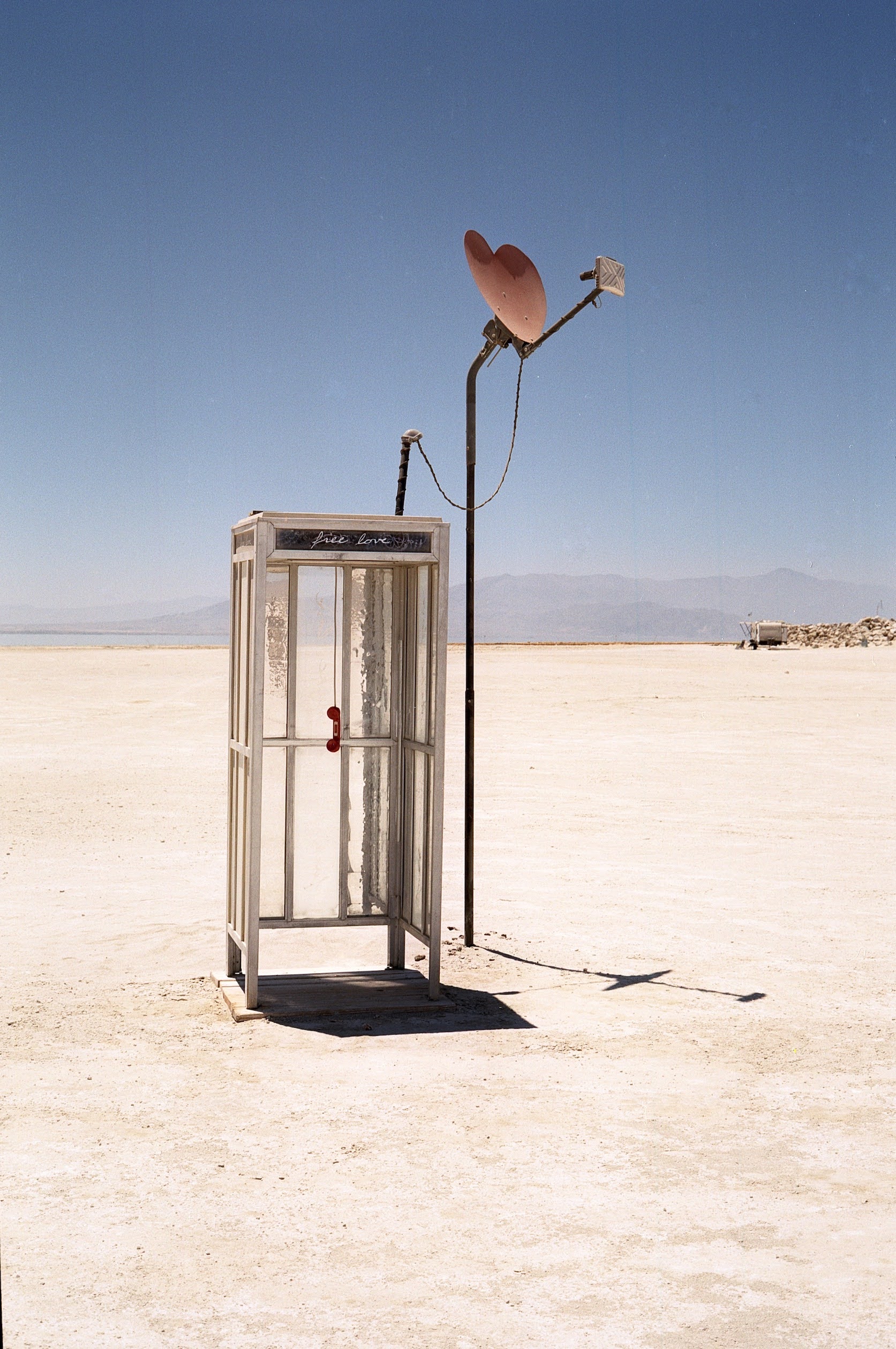
A sculpture at Bombay Beach, 2022. Photograph by Ben Clark.
Sources
- Shelley, Percy Bysshe. “Ozymandias.” Poetry Foundation, Poetry Foundation, https://www.poetryfoundation.org/poems/46565/ozymandias.
- Lynch, David, director. Blue Velvet. The Criterion Collection, 1986.
- Fitzgerald, F Scott. The Great Gatsby. Scribener, 1925.
- Benjamin, W., Tiedemann, R., Eiland, H., & McLaughlin, K. (2002). In The arcades project (pp. 11–23). essay, Belknap Press of Harvard University Press.
- Lytle, Mark H. The All-Consuming Nation: Chasing the American Dream since World War II. Oxford University Press, 2021.
- Blanché, Ulrich. “Terms and Definitions.” Banksy: Urban Art in a Material World, Tectum, Marburg, 2016, pp. 19–59.
- Voyles, Traci Brynne. “Flood.” Settler Sea: California’s Salton Sea and the Consequences of Colonialism, Univ of Nebraska Press, S.L., 2022, Pp. 55–68.
- O’Reilly, John. “A Fighting Fish for the Salton Sea.” Sports Illustrated, 12 Aug. 1957, https://vault.si.com/vault/1957/08/12/a-fighting-fish-for-the-salton-sea. Accessed 20 Apr. 2023.
- “History of Bombay Beach.” Bombay Beach Arts and Culture, https://bbartsculture.org/new-page#:~:text=Twenty%2Dfour%20years%20after%20a,of%20the%20new%20Salton%20Sea.
- Abunassar, Lauren. “Bombay Beach Biennale, Art That Asks Questions of a Living Ghost Town.” Los Angeles Magazine, 8 Apr. 2023, https://www.lamag.com/culturefiles/at-the-bombay-beach-biennale-art-asks-questions-of-a-living-ghost-town/.
- Anderson, Ian. “How Bombay Beach Has Gone from Apocalyptic Desert Wasteland to Offbeat Art Hub.” Roadtrippers, 12 Feb. 2019, https://roadtrippers.com/magazine/bombay-beach-apocalyptic-wasteland-art-hub/.
- Gerrie, Anthea. “Desert Art: Bombay Beach Biennale and the Revival of a Forgotten Town.” DesignCurial, 12 Apr. 2019, https://www.designcurial.com/news/feature-bombay-beach-biennale-7139390/.
- Pritchard, Stephen. “The Artwashing of Gentrification and Social Cleansing.” Handbook of Displacement, Palgrave Macmillan, 2021, pp. 179–194.
- Kracauer, Siegfried, and Thomas Y. Levin. “Farewell to the Linden Arcade.” Mass Ornament: Weimar Essays, Harvard University Press, S.l., 1995, pp. 337–342.
- Benjamin, Walter. “On the Concept of History.” Walter Benjamin – Select Writings, edited by Edmund Jephcott, vol. 4, The Belknap Press, Boston, Massachusetts, pp. 388–407.
 Ben's Lens